In the heart of Bogotá, the Gold Museum of the Bank of the Republic of Colombia presents an extraordinary collection of finely crafted pre-Hispanic objects, providing an insight into the relationship between indigenous peoples and precious metals. Reopened in 2009 with a striking new scenography, this unique museum, which welcomes 500,000 visitors a year, is probably one of the most fascinating in Colombia.Now located opposite the Parque de Santander, in the heart of Bogotá,the Gold Museum was created in 1939, following the acquisition by the Bank of the Republic of Colombia of an extraordinary piece: the Poporo Quimbaya, a priceless gold vase dating from 300 BC, which was probably used as a symbol of the Colombian cultureC., which was probably used for the various religious rites of the Quimbaya peoples (lime mixed with coca leaves was ground into it), who lived in the Cauca river valley.
Collections unique in the world
Since then, the collections have grown considerably: the museum has some thirty-four thousand pieces of gold and tumbaga (an alloy of gold and copper), and almost thirty thousand more in ceramics, precious stones, shells and bone, corresponding to the different indigenous cultures of Colombia: Calima, Muisca, Nariño, Quimbaya, Zenú, Tairona, San Agustín, Tierradentro, Tolima….
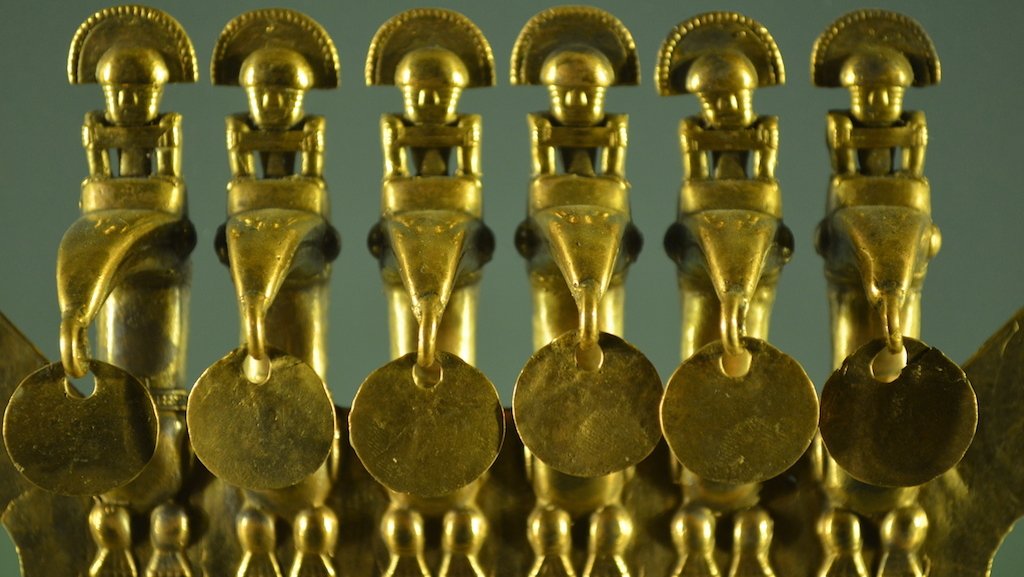
These rare pieces bear precious witness to the silversmithing talents of pre-Hispanic civilizations. Platinum worked by the Calimas Indians in the Tumaco region, silver chased by the Pastos Indians in the Nariño region, metamorphosed copper, filigree, lost-wax technique, granulation soldering..
The various objects on display reveal the extent to which indigenous peoples had an exceptional mastery of metallurgy, 1,500 years before the arrival of the conquistadors. The four large galleries that make up the Musée de l’Or take a closer look at how the ores were extracted and the different techniques used to work the metals. To enter the museum is to stand in awe of countless small marvels, their lines drawn with incredible precision.
You’ll discover all kinds of objects: jewelry (necklaces, earrings, bracelets, narigueras – nose ornaments -, brooches…), everyday tools (fishhooks, needles, combs…) and even textiles (in Quindio, the Quimbayas Indians also used gold for clothing).

Perhaps the most striking area is the “Salon Doré”, where 12,000 golden objects are displayed, glittering even more magnificently thanks to subtle lighting effects, accompanied by traditional music.

But the real treasure of this museum is not the collection of precious objects per se, but the thinking that gave them meaning. As you tour the museum, you’ll discover how gold, linked to the Sun (for the indigenous peoples, gold is the “sweat of the Sun”), held a special place in pre-Hispanic civilizations: a symbol of power, this precious metal was destined above all for the political and religious elites of the various pre-Hispanic peoples.
The museum’s collections reveal how Colombian gold gave rise to the famous myth of “El Dorado”, the legendary land teeming with precious metals: a myth that originated in the Bogotá region in 1536 and was relayed by the conquistadors, who were astounded by the opulence and mastery of gold of the natives.
Practical information
Museo del Oro, Cra. 6 #15-88, Bogotá, Cundinamarca, Colombia. +57 1 34 32 222 Audioguides available in French (3000 Pesos). Free for under-12s and over-60s. Also free on Sundays. Closed Mondays
Good to know
Since 1968, the museum has been housed in a building designed especially for it by Germán Samper Gnecco, who won the 1970 National Architecture Prize for his work. The Bank of the Republic sponsors other branches of the Gold Museum throughout Colombia. Link to the museum on Google Art Project