Places like Piedra del Peñol, Guatape, Poblado and Comuna 13 are a must if you want to spend a few days in Medellin. Nevertheless, it’s all the more interesting to discover places that are a little different and unexpected. So we set off to discover another facet of the city, less touristy, more gourmet and very atypical.
Amaga, an exotic gastronomic tour
So the whole team got together for an early morning departure for Amaga , 45 minutes from Medellin. At the entrance to the village, our guide Julio suggests we take a relaxing break and have a cafecito (small coffee in Spanish) in a magnificent house with a large garden and swimming pool, set in the middle of the mountains. The small houses in Amaga are built along the old railroad line, which is now a hiking trail. The rails were removed because they were too narrow for today’s train models, and they have sometimes been recycled by locals in the construction of their houses. We set off with our guide for a half-hour walk towards our first activity: an introduction to arepa-making.

A Colombian couple welcomes us to their rustic farmhouse. On the table, we find a container filled with yellow corn that has been cooking for over 4 hours, and an archaic hand-cranked machine used to grind the kernels. It produces a paste with which to form a centimetre-thick cake, which is then cooked over a wood fire.
after 10 minutes of cooking, a little butter, salt and a slice of cheese are added and left to melt on top. Colombians eat arepa for breakfast, lunch or dinner. It can be served as a side dish, in the same way we use bread in France, or as a snack.

After this delicious breakfast, we continue our walk for another 30 minutes along the old railroad.
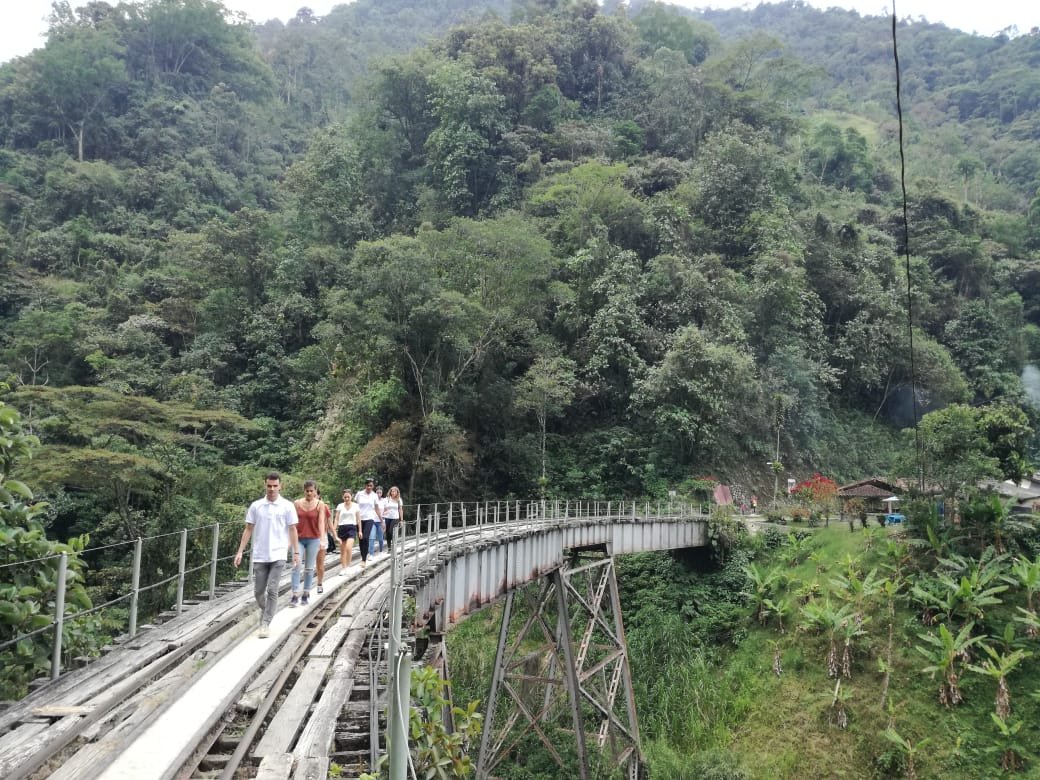
Overlooking a chasm more than 40 metres deep, we cross an old viaduct on which the rails are still in place, and wooden planks are used to fill the holes. This viaduct is one of the last remnants of the old railroad line, along with the 6 tunnels that must be crossed to reach the next destination.
We then reach another farm, which serves as a restaurant for the locals. Here, our guide suggests we try mazamorra, a popular Latin American dessert made with corn soaked in milk and accompanied by bocadillo (guava paste).
To finish, we’re served a plantain fritter filled with cheese and bocadillo. Surprising, but very tasty. This delicacy, much appreciated by the team, is called the aborrajado.

So it’s with full bellies that we set off again from this charming region, perched in the Antioquian mountains. A jeep takes us back to the minibus, and we’re off in the direction of Medellin.
A coffee finca in the hills above Medellin?
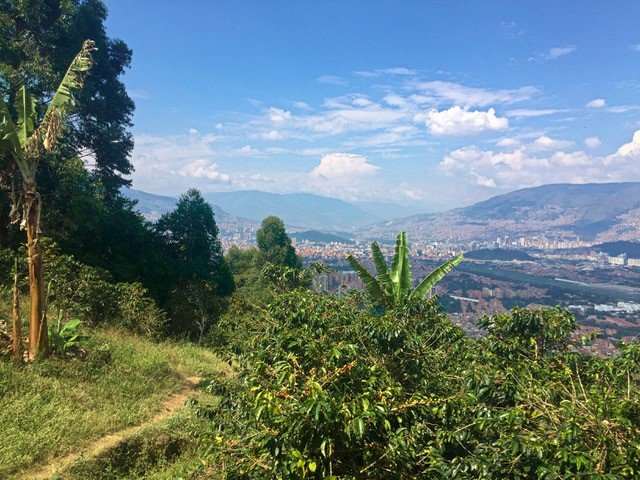
Back in town, we quickly escape the traffic to climb a hill overlooking Medellin. Just 15 minutes from the city center, but in the middle of nature, at the coffee finca. Over 60,000 coffee plants are planted on the 40,000-hectare estate. We are welcomed by the owner on a terrace with a magnificent view of the city. A short course on the different stages and ways of preparing the beans is then offered, before a tasting of the local coffee, as well as a coffee flower tea. It’s impressive to discover a coffee finca with its own plantations so close to the city.

Moravia, more than a neighborhood, a community!
We end the day with a guided tour of Moravia by twin sisters from the local community. First of all, we climb Moravia‘s large garbage hill, a former landfill that has been covered with earth to create beautiful gardens, plantations and a collaborative orchid-growing project. The aim is to try and clean up this garbage as deeply as possible, thanks to the benefits of trees and plants. We then visit the rest of the district, ending with the Moravia cultural development center and a presentation of all the artistic projects that are being set up thanks to this site.


And so the day comes to a close, having enabled the whole team to discover some of Medellin’s lesser-known and unexpected places, adding to the activities already available in “the city of eternal spring”.